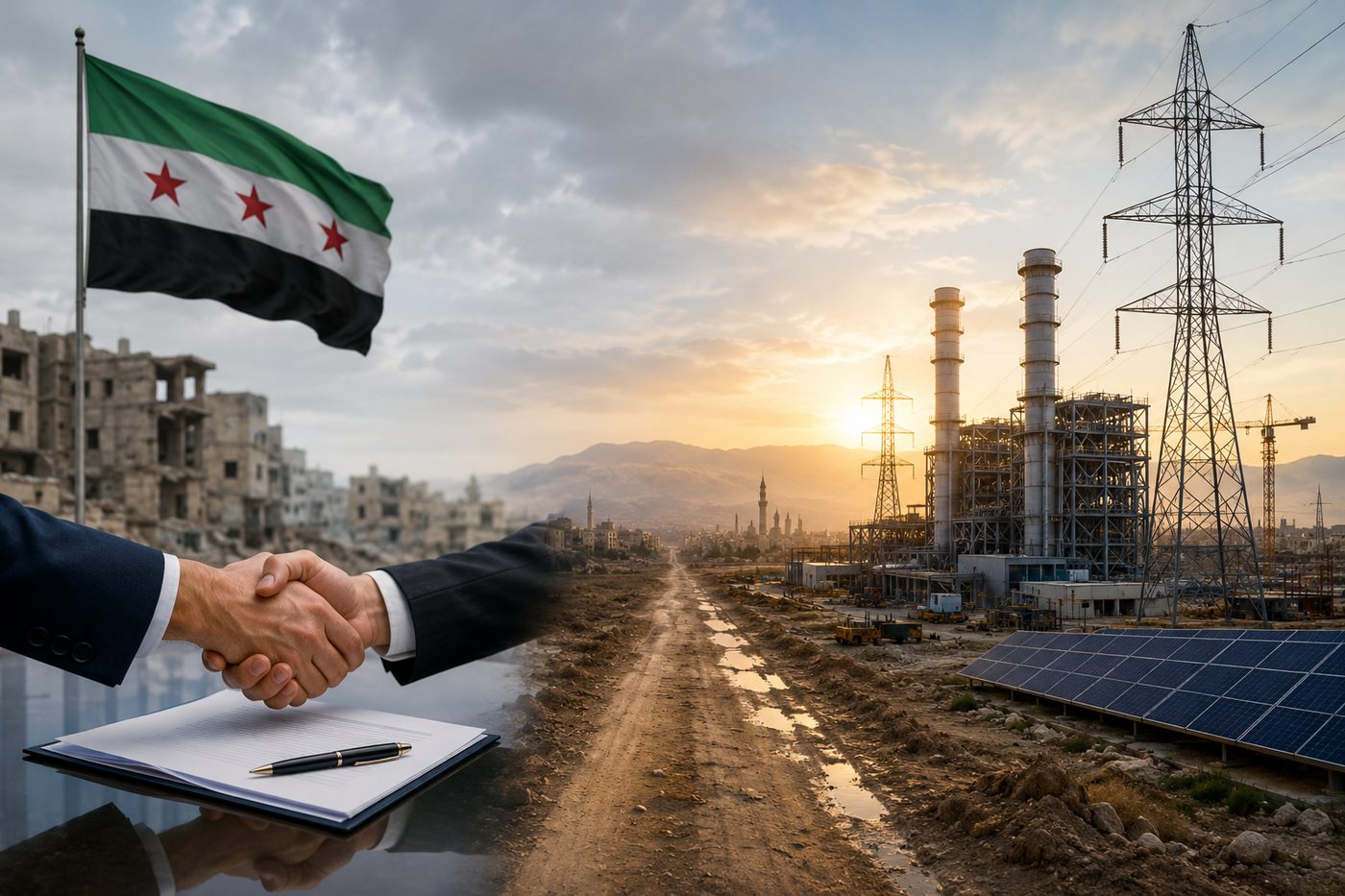
Syria in 2026: The Distance Between a Signed Memorandum and a Working Megawatt
Announced investment now exceeds the size of Syria's entire economy. Reading that gap correctly is the difference between a market entry strategy and an expensive press release.
In July 2025, more than one hundred Saudi companies arrived in Damascus and signed forty-seven agreements worth $6.4 billion in two days, with President Ahmed al-Sharaa in the room. A month later, a single ceremony added another $14 billion. By this summer, investment commitments from the Gulf alone exceed $28 billion. Now set that figure against the economy meant to absorb it. Syria's GDP stood at an estimated $21.4 billion in 2024, down from $67.5 billion in 2011. Announced investment has overtaken the size of the entire national economy it intends to enter.
That arithmetic admits two readings. The first says Syria is the last great frontier market, a nation rebuilding from its foundations, and the commitments prove it. The second says this is announcement inflation, the oldest pattern in post-conflict economics, and most of that capital will never break ground. Both camps quote the same numbers, and both are partly right, because they are right about different things. The legal and financial reopening of Syria is real, and it has moved faster than almost anyone predicted. The capacity of the Syrian economy to absorb what has been promised is not yet real. Every sound entry decision in 2026 begins with knowing which of the two you are looking at.
The reopening is administrative fact, not press release
Start with what has actually changed, because it is more than the sceptics allow. The sanctions architecture that sealed Syria off for more than a decade was dismantled in under a year. The European Union lifted the bulk of its economic restrictions in May 2025. Washington revoked its comprehensive embargo by executive order the following month. On December 18, 2025, the US Congress repealed the Caesar Act, the statute whose secondary sanctions had taught third-country banks to treat Syrian exposure as radioactive. The state sponsor of terrorism designation followed it out the door. What remains are targeted measures against individuals tied to the former regime, its abuses, and the captagon trade, which is to say the kind of list-based screening obligation that applies in any frontier market.
The financial plumbing is being reconnected with similar speed, and this is the detail that separates Syria's trajectory from the cautionary precedents. After the 2015 nuclear deal, Iran was formally open for business for years, yet European banks never restored correspondent relationships and the opening died on the vine. Syria in 2026 looks different. In March, the central bank reactivated its account at the Federal Reserve Bank of New York for the first time since 2011. Reconnection to SWIFT is underway. This month, Visa and Mastercard resumed card processing after a fifteen-year absence, and Qatar National Bank switched services on within days. On the trade side, US export licences that took nine months to process a year ago now clear in about six weeks, with no recorded rejections since the embargo fell. Roughly 18,000 new companies registered in Syria over the past year.
Capital has followed the paperwork. DP World signed a 30-year concession for the port of Tartous with an $800 million modernisation commitment. AD Ports is expanding at Latakia in partnership with CMA CGM. Qatar's UCC Holding anchors the two largest commitments in the country, a $7 billion power generation programme and a $4 billion rebuild of Damascus International Airport, both under contract since late 2025. Dana Gas of Sharjah signed a preliminary agreement to redevelop gasfields near Homs. Saudi Arabia's newly launched Elaf fund has committed $2 billion to develop two airports serving Aleppo, and Saudi operators are moving on roughly $1 billion in telecommunications infrastructure. Azerbaijani gas has been flowing to Syrian power stations through Turkey since August 2025 under a SOCAR agreement covering 1.2 billion cubic metres a year.
So the lazy dismissal, the claim that nothing ever actually happens in these stories, is already wrong. Ports have operators. Gas is flowing. Cards are processing. Anyone still writing Syria off as pure theatre has not looked at the record since the spring of 2025.
The capacity ledger
Now hold the other column of the ledger up to the light.
In October 2025 the World Bank published its physical damage assessment covering 2011 to 2024, the first rigorous nationwide count. Its findings frame everything else. Reconstruction will cost an estimated $216 billion, roughly ten times the country's current annual output. Direct physical damage alone comes to $108 billion, of which infrastructure accounts for $52 billion, residential buildings for $33 billion, and non-residential buildings for $23 billion. Real GDP contracted by about 53 percent between 2010 and 2022, and near-term growth projections have hovered around a single percentage point. If every dollar of the $28 billion in commitments were wired tomorrow, it would cover about an eighth of the need.
But the deeper constraint is not the size of the bill. It is the economy's capacity to metabolise capital, and three bottlenecks govern it.
The first is power. Syria had roughly 8.5 gigawatts of installed generation capacity in 2011. Available capacity today is closer to 2 gigawatts, which until recently translated into two to four hours of daily supply across much of the country. The government's target is eight hours nationwide, extending to fourteen by the middle of this year, helped by Azerbaijani gas feeding rehabilitated plants in Aleppo and Homs with an expected 1,200 to 1,300 megawatts of generation, and by Turkish electricity exports planned at 900 megawatts. Reporting from Damascus this month confirms that supply has improved and that the new tiered tariffs are painful for households and firms alike. Every other business plan in the country sits downstream of this single variable. A factory, a cold store, a data centre, a hotel: each is, before anything else, a bet on the grid.
The second is banking. The redenomination that took effect on January 1, under Decree 293 of 2025, struck two zeros off the pound and put the first post-Assad banknotes into circulation. It simplifies transactions and carries symbolic weight, but a currency swap does not recapitalise banks. Syria's lenders remain thinly capitalised, short of correspondent relationships, and short of the trust of a population that spent a decade learning to hold its savings in dollars outside the system entirely. The consequence, as the regional trade press has put it precisely, is that Gulf liquidity is outpacing Syria's financial reconnection. Money wants in faster than the pipes can carry it.
The third is rules. Saudi Arabia's multibillion dollar push arrived, as Forbes observed in February, before the rules existed. Which law governs a build-operate-transfer concession, how land title is established when thirteen years of displacement have layered claim upon claim, how a dispute with a state entity gets resolved and then enforced: these questions currently have provisional answers at best. Property restitution is the sleeping giant among them. Millions of displaced Syrians hold claims on homes and land that others now occupy or that new projects may cover, and no comprehensive mechanism yet exists to clear them.
Security, while transformed, is not settled either. Episodes of communal violence on the coast in March 2025 and in Sweida in July 2025, and a persistent Islamic State remnant, are reminders that the state's monopoly on force remains a work in progress.
None of this argues that the opening is false. It argues that a memorandum and an operating asset are different economic objects, and that most of the $28 billion currently sits somewhere on the long road between those two states.
The gap is not a flaw in the market. It is the market.
Post-conflict economies reliably produce this divergence between announced and executed investment, and the record elsewhere suggests the ratio can be brutal. Iraq after 2003 became a graveyard of memoranda. Lebanon's reconstruction enriched a construction and political complex while the grid stayed broken for thirty years. The pattern is common enough to have a logic: announcements are cheap coordination devices. Governments need momentum, investors need optionality, and a signing ceremony supplies both at zero marginal cost.
The mistake is to stop the analysis there, shrug, and walk away, because the space between commitment and capacity is not dead air. It is an order book. Every constraint listed above is somebody's revenue line. Two missing gigawatts are a power market. Undercapitalised banks are a mandate for trade finance, payment rails, and eventually foreign bank entry. Absent rules are a market for structuring, insurance, and compliance work. A $52 billion infrastructure deficit is, concretely, demand for cement, steel, transformers, switchgear, pumps, pipes, and the logistics to move all of it through two newly corporatised ports. The 18,000 new company registrations are not megaprojects. They are restaurants, workshops, importers, and contractors, and they buy inputs every week.
This is why the firms making money in Syria in 2026 are mostly not the ones in the headline photographs. They sell into the bottlenecks: solar kits and generator fuel while the grid heals, payment workarounds while the banks reconnect, customs brokerage while procedures stabilise, vocational training while a scattered workforce comes home. The megaproject economy runs on announcements. The constraint economy runs on invoices.
One swing variable could compress the whole timeline: people. The war scattered millions of Syrians, among them a large share of the country's engineers, physicians, financiers, and entrepreneurs, and returns have been building since the end of 2024. The diaspora's decision calculus mirrors the investor's. They are watching the same electricity hours, the same banks, the same property questions. Each returning family is a micro-investor with local knowledge, a claim to settle, and a livelihood to rebuild. If returns accelerate, the constraint economy gains its customers and its workforce in the same motion. If they stall, no volume of Gulf capital will substitute for the missing middle of Syrian society.
A playbook for entry
For a firm weighing entry, the discipline that matters is sequencing, and the useful mental model is a decision cycle rather than a gold rush: observe, orient, decide, then act, in that order and at a faster tempo than the competition.
Observe before anything else, and observe execution rather than announcement. Watch hours of electricity delivered, not gigawatts promised. Watch container throughput at Tartous and Latakia now that DP World and CMA CGM have their own capital at risk. Watch whether UCC's power programme hits its milestones, whether card transaction volumes grow, whether licence processing times keep falling. These markers are public, cheap to monitor, and nearly impossible to fake, which makes them worth more than any ministerial statement.
Orient against constraints, not glamour. The instinct is to chase the sectors in the press releases, real estate above all. The better question is which bottleneck your capability relieves. A seller of enabling goods and services gets paid by every project that proceeds, whichever consortium wins the headline, which is the closest thing to a diversified position this market offers.
Decide with reversibility built in. Stage capital against observable milestones rather than committing at the valuation the excitement implies. Vet local partners hard, because the remaining targeted sanctions lists still carry real OFAC exposure and the repeal of the Caesar Act did not repeal due diligence. Seat dispute resolution offshore while domestic enforcement is unproven. Price political risk honestly, and buy cover where it exists.
Then act small and deliver. In an economy saturated with announcements, delivery is the scarce commodity, and scarcity commands a premium. A commissioned ten-megawatt solar plant, a functioning cold chain, a training centre that graduates its first class: assets like these buy standing with the government and the market that no memorandum can. Reputation compounds, and in Damascus in 2026 it may be the hardest currency in circulation.
On the ground: recommendations for the foreign investor
Much of what this article argues crystallised for us in Damascus rather than in any dataset. The distance between the Syria of the headlines and the Syria of the street is itself instructive: generator cables strung across the alleys of the old city, exchange offices quoting the new pound beside shops that still think in dollars, registry counters crowded with people forming companies. The first recommendation follows directly. Do not attempt this market by videoconference. Presence is the entry ticket. Walk the souks, tour the industrial zones, sit in the traffic. A week of ground truth will recalibrate assumptions that no report, this one included, can correct at a distance.
Second, choose partners for verifiable standing, not promised access. The commercial families who kept factories and trading houses alive through thirteen years of war carry operational knowledge and community trust that no newcomer can replicate, and they are identifiable through the chambers of commerce and industry. Verify beneficial ownership in every structure, screen every counterparty against the sanctions lists that survived the Caesar repeal, and be wary of intermediaries selling exclusivity. One pattern held across our conversations: the most credible people undersold their connections, and the loudest claims of access came from those with the least of it.
Third, structure the money conservatively. Route establishment through the Syrian Investment Authority and put licences in order before capital moves. Keep treasury offshore in the early phase, fund operations in tranches, invoice in hard currency where the framework allows, and migrate to the reconnected banking channels as correspondent relationships mature. Document everything to a standard your home regulator would applaud, because the banks now re-entering Syria will ask, and clean paper will be a competitive asset.
Fourth, build with Syrian people rather than around them. The returning diaspora supplies managers who speak both the language of international finance and the grammar of local negotiation. Train aggressively, since the skills deficit is real but shallow, sitting on top of a commercial culture older than the state itself. And invest in the municipality as seriously as in the ministry. Permits are granted in Damascus, but projects succeed or fail in the neighbourhood.
Fifth, size expectations to the friction. Power, connectivity, and paperwork will each tax the calendar, so pilot small, prove the model, and scale on evidence. What stays with a visitor, though, is the pace of small repair: shopfronts repainted, hotel floors rewired one at a time, cafés full late into the evening. The country is not waiting for the megaprojects, and neither should an entrant's business plan.
The bottom line
Syria's reopening is that rare thing, a story in which the hype and the opportunity are both real. They simply belong, for the most part, to different actors. The $28 billion in commitments tells you where the attention went. The $216 billion assessment tells you where the need is. The two gigawatts on the grid tell you where the work starts. Countries are not rebuilt at signing ceremonies. They are rebuilt kilowatt by kilowatt, container by container, ledger entry by ledger entry, and the firms that internalise that arithmetic first will own the decade that follows.
Sources
World Bank, Syria's Post-Conflict Reconstruction Costs Estimated at $216 Billion, press release, October 21, 2025, and The Syrian Conflict: Physical Damage and Reconstruction Assessment, 2011 to 2024.
The National, US directly engaged in Syria's economic recovery, State Department official says, July 14, 2026.
AGBI, Gulf investors are pricing in Syria's comeback, July 2026, and US terror delisting opens Syria to Gulf investors, July 2026.
Saudi Gazette, Saudi-Syrian Investment Forum 2025 seals $6.4 billion in deals, new joint business council formed, July 2025.
Just Security, Caesar Act Repeal and the Syria Sanctions Removal Report Card, 2025.
Norton Rose Fulbright, Syria Power Sector Guide 2026.
The National, Turkey aims to export 900MW of electricity to Syria by first quarter of 2026, August 12, 2025.
Al Jazeera, It's expensive: Syria's electricity has improved, but challenges remain, July 13, 2026.
Forbes, Saudi Arabia's $3 Billion Syria Reconstruction Push Has One Problem: No Rules Yet, February 9, 2026.
MEED, Gulf liquidity outpaces Syria's financial reconnection, 2026.
bne IntelliNews and SANA on Decree 293 of 2025 and the two-zero redenomination of the Syrian pound, December 2025 to January 2026.